

Solveig Uglem and Hanne Dalsvåg, SINTEF Ocean
Creating a new food product with seaweed begins long before the prototypes reach to a sensory test. In SEAFOODTURE, the first stage included a combination of the results from a consumer study and screenings of different products and raw materials to find the best ideas and applications to incorporate seaweed in.
Much of the work was performed in our kitchen lab, where researchers from SINTEF Ocean combine cooking skills with systematic and scientific testing. The goal is to understand how different products, ingredients and processing steps works with different species and amounts of seaweed. Initially, we started the screening phase with different raw materials; pork meat, lean white fish, salmon and rice and the seaweed species Graciliaria, Palmaria, Ulva and Porphyra (nori). The initial tests narrowed the recipe optimalization phase down to fish fingers with lean white fish and ulva, salmon burgers with porphyra and rice balls with both ulva and porphyra.
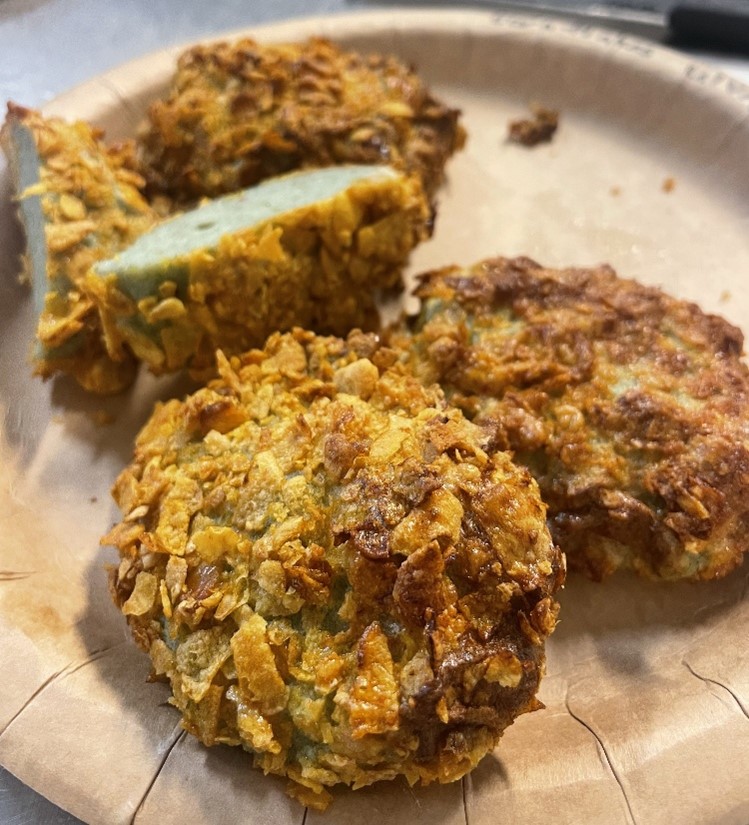


Photo: Solveig Uglem, SINTEF Ocean
The recipe and process development phase is an iterative phase where multiple rounds of experiments guide further fine‑tuning where each experiment brings the product with seaweed one step closer to its final form. Each trial is documented carefully so that promising combinations can be repeated and refined. A critical step is sensory and functional testing. Small batches are tested for processing parameters and cooking losses and evaluated for taste, appearance and mouthfeel. Fish fingers and salmon burgers are also tested with textural analyses.

Photo: Solveig Uglem, SINTEF Ocean
When recipe and process show stable, desirable results in small‑scale trials the next step is the sensorial analyses. In SEAFOODTURE a sensorial test was performed by our colleagues from Innovate Solutions. We look forward to reviewing the results of the sensory evaluation, bringing us one step closer to the final prototypes!
Cover photo: Hanne Dalsvåg, SINTEF Ocean